Introduction
Hi! My name is Mary, and I am about to enter my third year at Siena College. I am a Psychology major with a Criminal Justice minor. Psychology is a field dominated by women, with a 2013 report finding that 68.3% of psychologists are female, and after graduation I plan on continuing school to get a doctorate, in which women are also the majority. My hometown is Utica, NY, a little city right in the center of the state.
If you’ve ever heard of Utica, you’ve definitely heard some of its nicknames. which include Sin City, The City That God Forgot (hilarious), and The Town That Loves Refugees.
I myself fall into the 63.4% of the population that is white, but Utica also has a population that consists of 15.8% black or African Americans, 11.9% Asians, 4.6% of people who are two or more races, and many, many more.
Some of my interests include writing, reading, and music. Throughout school, I’ve played trumpet and piano, performing with my school’s jazz and marching bands. I also love theatre, some of my favorite shows being Phantom of the Opera, Hadestown, The Book of Mormon, and The Hunchback of Notre Dame. Another really important part of my life is comic books and superheroes.
Deviant Subculture of Heroes
Howard S. Becker attacks the idea of deviancy with its one traditional viewpoint: deviancy as an attribute of the individual. However, Becker argues that “whether an act is deviant…depends on how other people react to it (11).” Therefore, a deviant subculture that I am a member of actually has to do with my love of comics and superheroes. The reason I focus on this specific subculture is because as heroes go through the cycle of phasing in and out of the mainstream, women are consistently targeted for liking quote unquote “nerdy” things.
It is true that comic books are a male dominated interest nowadays. However, in the 1940s, around the time when comics first started exploding into pop culture with heroes like Batman, women made up half the audience. So what changed?

It could be argued that nothing changed. Considering the time period and the heroes that came about as a kind of propaganda, like Captain America or Superman, it was the American thing to do to support these stories. Plus, knowing that it is so hard to not get caught up in the excitement of something new and unheard of, we can speculate that this may have been an influence.
However, this doesn’t explain why the demographic has changed over time. Why is the superhero audience no longer 50/50? Well, it is incredibly important to note who is making the comics. As of late, women have been becoming more and more involved in fandom communities, and this may be thanks to a 2018 statistic in which more women are entering the profession as writers, editors, artists, and all other positions.
Below are the 2018 statistics for females in the comic book profession from two of the most popular comic companies, DC and Marvel.


This is a huge improvement from 2011, in which the overall percentage for both companies was around 10%. No one should be surprised that women become increasingly involved in consuming comic books when they see themselves in them, and this applies to any and every minority. If a consumer can relate to a product, they’re motivated to support that product.
Different Kinds of Deviancy
There are two specific brands of deviancy I’m going to be looking at, and I’ve already covered one with the section above. Featured above is what Becker refers to as “statistical deviancy,” which, simply put, is “anything that varies too widely from the average.” In terms of generality, women who read comic books and interact with related content are a statistical minority, as I’ve discussed with mention of a mainly male audience, and mainly male creators.
Another kind of deviancy is referred to as “stigmatized deviancy,” which we see in the acts of gatekeeping. For the purposes of this article, we will only cover gatekeeping in terms of male fans against female fans. However, before we can discuss that, it is important to understand just what stigmatized deviancy is. Becker does not directly use this phrase, but it can be related easily to the concept at hand. Becker talks about sociologists looking at deviance as something that either disrupts or promotes stability (7). The argument is incredibly sexist, but it can be argued that female comic fans are “disrupting stability” by going against the gender expectations of women. Women aren’t supposed to like things with violence, women aren’t supposed to get involved with topics that are as significant as the political and social ones heroes are meant to tackle. In short: men and women are meant to be in separate spheres, and not overlap in interests. When this happens is when we see the emergence of gatekeeping.
Ask any woman that enjoys a “male” interest, and she’ll be able to tell you all about the backlash she’s received, essentially just for minding her own business. Gatekeeping is defined on UrbanDictionary as “when someone takes it upon themselves to decide who does or does not have access or rights to a community or identity.” In the comic community, this is a constant and dehumanizing practice, focused on keeping others out. It is present when people of color or people with disabilities are told they aren’t allowed to cosplay a certain character because that character doesn’t look like them, for example. For women, comic gatekeeping can take the form of men randomly quizzing you to “prove” you know your stuff, or to make sure you’re “worthy enough” to enjoy a thing.
Gatekeeping as a Means of Enforcement
All of these things may sound valid on paper (or, in this case: onscreen), but no amount of research can replace personal experience. There are entire Reddit threads dedicated to sharing stories of gatekeeping in the nerdy, male dominated communities. Reddit user, lordofpurple, recalls one instance:
Once my girlfriend (at the time) and I walked into this new gaming/TCG store to check it out. As soon as we walked in it was like the saloon scene in a Western: all the sound stop and every eye turned towards us and just fucking STARED until we left. I want to relate to nerds in my town but they’re all so fucking uncomfortable when they do shit like that
When situations like this one occur, those angry male nerds become their own moral entrepreneurs and rule enforcers. A moral entrepreneur is, according to Becker, someone who sees an issue and decides that something needs to be done about it. In this case, a female in a “male-only” space. However, the unique element of this is that moral entrepreneurs don’t get their hands dirty. They are worried about the ends, and have others worry about the means. Those who worry about the means are the rule enforcers, who have a self-explanatory title. Uniquely, gatekeeping allows these moral entrepreneurs to enforce their own values, as previously mentioned in lordofpurple’s account, where he talks about being essentially forced to leave a business, based on the nonverbal behavior of the patrons and the pressure they put on the couple.
An important note that Becker makes about moral entrepreneurs is that they believe that their “reform will prevent certain kinds of exploitation of one person by another (148).” Generally, it is believe that women will “take over” comics and superheroes, and “ruin” them for the male fans.
Is There Any Truth to These Claims?
The answer is a resounding no. Earlier, I discussed the positive correlation between female readership and more female creators. The two years I covered were 2011, where 10% of staff were women, and 2018, where the range of female creators was around 16-17%. To know for sure whether comics are being “ruined,” the best thing to do is to look at sales. If a product is becoming worse, supposedly, fewer people should be purchasing it.
In 2011, the overall sale in North America was around $414 million. By 2018, that number grew by more than $100 million, to be a total of around $516.59 million.
Now, please note that the previous statement is based on a positive correlation. It does not take into account the fact that successful movies about these heroes could influence comic book sales, which is a very valid point. However, it is just as valid to emphasize that such an increase happened within the same time frame as the increase of females in the profession. It would be irresponsible and willfully ignorant to ignore the fact that women have the power to bring such positive change to so many different and diverse fields, and the comic book industry is no exception.
Conclusion
Women are still a minority in the comic book community, but the numbers are steadily growing as time goes on. A 2014 study has shown that women make up 46.67% of the population of comic fans. As we get closer and closer to approaching that 50/50 mark, it is important to note that no matter how many loyal female fans there are, numbers won’t defend them from males who think that the entire genre was made for them and them alone.
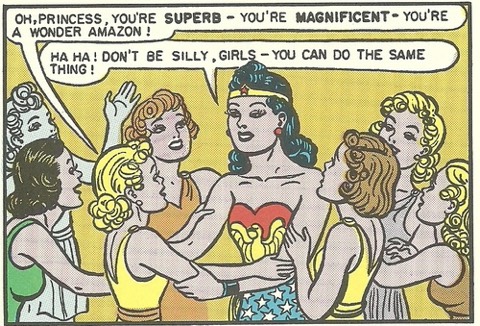
Comic books were created to help people escape the real world and enter one where innocent people were really, truly protected. That’s true of Jim Gordon being the only cop in Gotham that isn’t corrupt, of Superman and Captain America having roots in fighting Nazis, of Jessica Jones being an abuse survivor that refuses to let her abuser continue hurting her even after the initial abuse is over, and it’s true of Wonder Woman being a powerful female character that isn’t afraid to stand up for herself, a thing that a lot of young women and girls need to see.
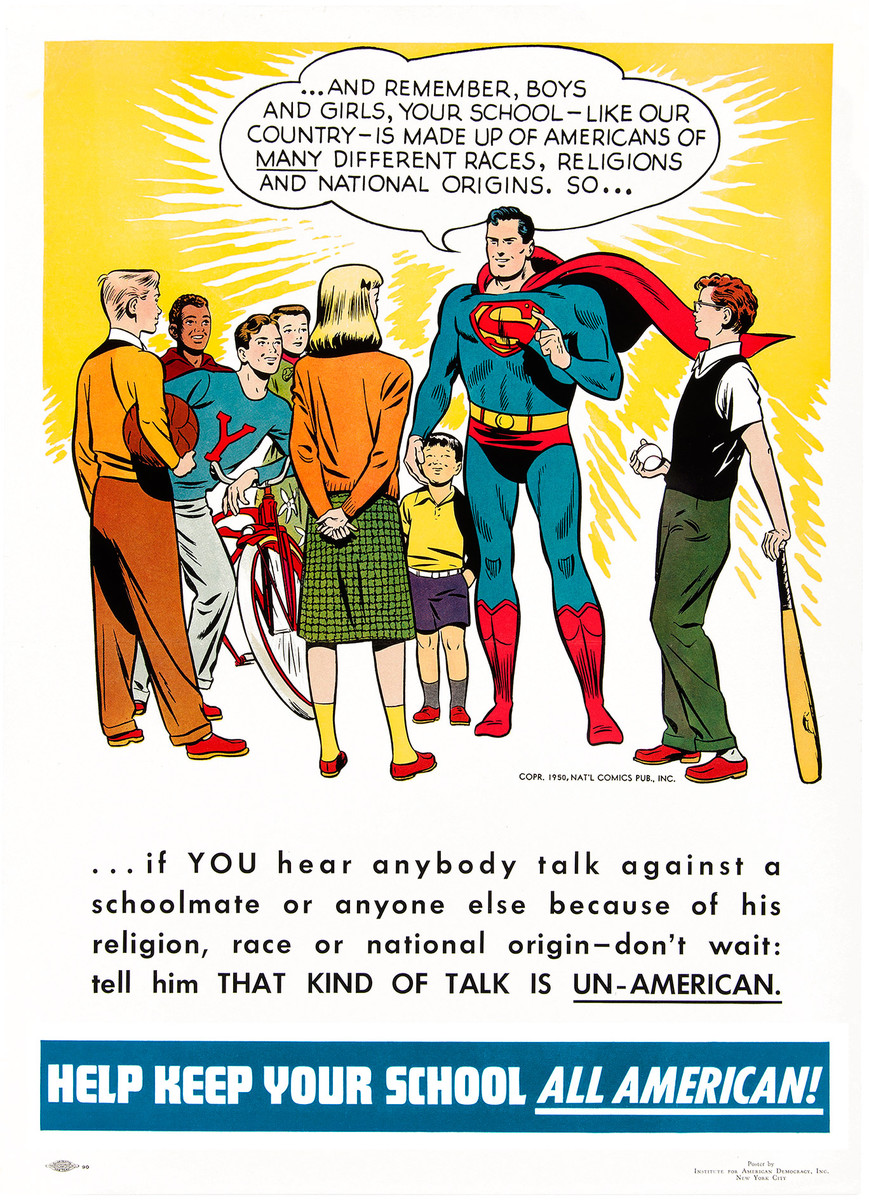
The most admired childhood superhero is Batman, with 22% of Asian Americans, 25% of African Americans, and 29% of Caucasians as respondents out of a group of 990. With numbers this close, why do we seem to think it matters who reads what? Heroes are meant to be shared, are meant to bring people of all different backgrounds together. Why would we want to ruin all the things that make the superheroes we love great?
Although we’re headed in the right direction, representation doesn’t end with women. Representation in comics needs to include sexual orientation, disabilities, race, and anything else a person could be. Comics were not made exclusively for straight white men, no matter what way you look at it. In fact, when you discuss representation of minorities in comics, it is crucial to remember that the superheroes we love so much today were created by Jewish men during the World War II era. These books were meant to inspire hope to those who needed it, not to be kept away from others we deem “unfit.”
Sources
Becker, Howard Saul. Outsiders: Studies in the Sociology of Deviance. Free Press, 1997.
Comichron. (2018). 2011 Comic Book Sales to Comics Shops. Retrieved May 27, 2019, from https://www.comichron.com/monthlycomicssales/2011.html
Comichron. (2018). 2018 Comic Book Sales to Comics Shops. Retrieved May 27, 2019, from https://www.comichron.com/monthlycomicssales/2018.html
Fowler, G., Cope, C., Michalski, D., Christidis, P., Lin, L., & Conroy, J. (December 2018). Women Outnumber Men in Psychology Graduate Programs. American Psychological Association. Retrieved May 27, 2019, from https://www.apa.org/monitor/2018/12/datapoint
Gatekeepers of Comics. (2014). Retrieved May 27, 2019, from
Gatekeeping. (2012). UrbanDictionary. Retrieved May 27, 2019, from https://www.urbandictionary.com/define.php?term=Gatekeeping
Geekwrapped. (2019). Superheroes of Color: Exploring Sentiment Toward Superheroes’ Races or Ethnicities. Retrieved May 27, 2019, from https://www.geekwrapped.com/superheroes-of-color
Hanley, Tim. (February 15, 2019). Women in Comics, By The Numbers: Summer and Fall 2018. Retrieved May 27, 2019, from https://www.comicsbeat.com/women-in-comics-by-the-numbers-summer-and-fall-2018/
Lin, L., Nigrinis, A., Christidis, P., & Stamm, K. (July 2015). Demographics of the U.S. Psychology Workforce. American Psychological Association for Workforce Studies. Retrieved May 27, 2019, from https://www.apa.org/workforce/publications/13-demographics/report.pdf
Phantom of the Opera. (2016). Retrieved May 27, 2019, from https://us.thephantomoftheopera.com/gallery/
Schenker, Brett. (February 5, 2014). Market Research Says 46.67% of Comic Fans Are Female. Retrieved May 27, 2019, from https://www.comicsbeat.com/market-research-says-46-female-comic-fans/
The Fishbowl Blog. (April 23, 2013). Pop Culture Propaganda- Captain America History!. Retrieved May 27, 2019, from https://nerdshavenothingbettertodo.wordpress.com/2012/04/23/pop-culture-propaganda-captain-american-history-101/
Utica, New York. (n.d.). In Wikipedia. Retrieved May 27, 2019, from https://en.wikipedia.org/wiki/Utica,_New_York

 Sociology of Deviant Behavior